Farm

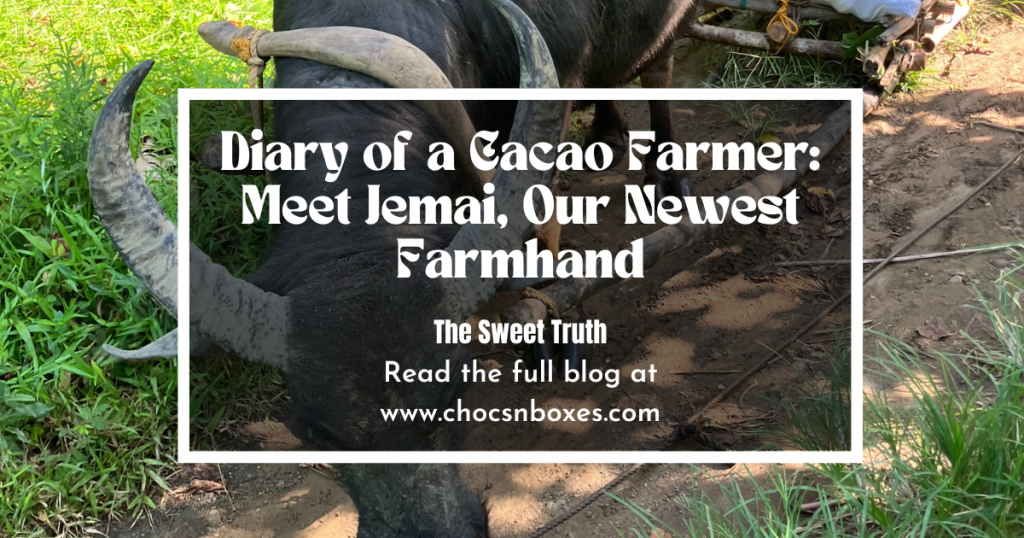
Diary of a Cacao Farmer: Meet Jemai, Our Newest Farmhand

Today was a special day on the farm—not just because of another bountiful harvest, but also because it marked the first time Jemai, our newest member, joined us for the cacao harvest. We’ve been eagerly anticipating Jemai’s arrival since she officially became part of our team on November 20. Jemai isn’t your ordinary worker; she’s a strong and beautiful female carabao who will help us in ways only she can. For chocolate lovers and bean-to-bar makers who trace every step of the cacao-to-chocolate process, you’ll love hearing how vital these moments are to creating chocolate magic.   Most of our cacao trees are nestled in Sitio Soboc, a hinterland so remote it’s accessible only by foot. For years, transporting our cacao harvest from the farm to civilization has been a logistical challenge. Normally, we’d rent a carabao from another farmer to help transport the heavy sacks of cacao pods from our various farm locations to the roadside. But this year, Jemai is stepping in. Today, she proved herself to be an absolute champ. Standing tall and steady, she pulled the wooden trailer we call a “kangga” (a traditional piece of farm equipment here in Samar). The kangga was piled high with freshly harvested sacks of cacao pods, and Jemai didn’t falter, not even when the trail got tricky. https://chocsnboxes-old.ad-wize.org/wp-content/uploads/2024/11/WhatsApp-Video-2024-11-28-at-9.35.44-PM.mp4 The path from Sitio Soboc is far from forgiving—it winds narrow and uneven, crossing streams and wading through thick mud. Yet Jemai carried on with strength and grace, pulling the load all the way to the nearest road where we could transfer everything onto a motorcycle with a sidecar. From there, the precious cargo made its way to our post-harvest facility in the city, ready to start the next leg of its chocolate-making journey: fermentation and drying. Watching Jemai traverse the rugged path and knowing the hard-earned cacao pods were safely on their way was a moment of deep gratitude for all of us. Farming is not for the faint of heart, and every harvest is a labor of love. Jemai may not know it, but she’s now an essential part of a process that results in handcrafted chocolate bars enjoyed by people far and wide. Here’s to Jemai, here’s to the harvest, and here’s to the chocolate that will one day tell the story of our hard work.  To all chocolate lovers and makers out there, every bean you taste has a story, and today was one filled with laughter, mud, streams, teamwork—and a very special carabao.  Until next time,   From our farm to your chocolate bar.

Diary of a Cacao Farmer: Meet Jemai, Our Newest Farmhand Read More »

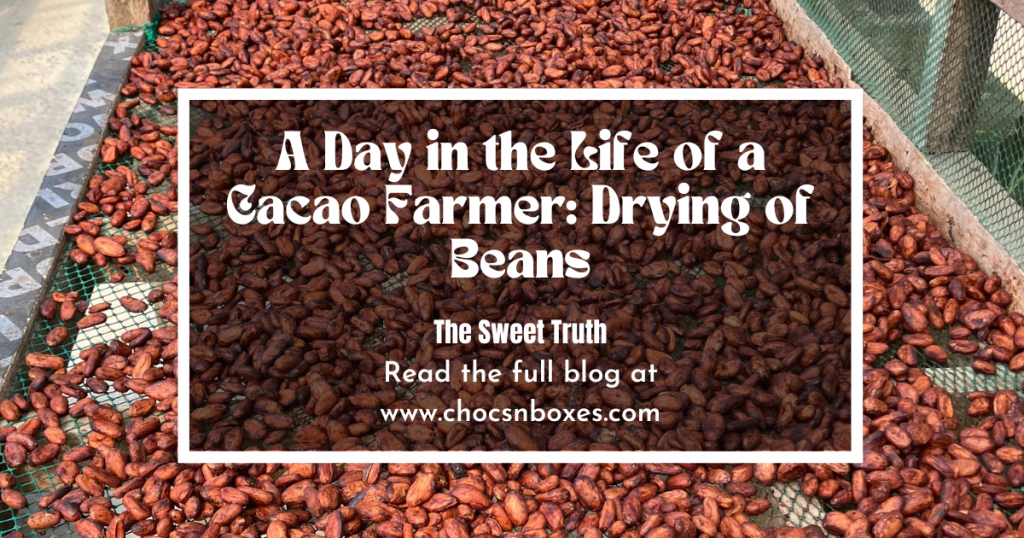
A Day in the Life of a Cacao Farmer: Drying of Beans

Today marked the beginning of the drying process for our freshly fermented cacao beans. After fermentation, it’s essential to dry the beans to reduce their moisture content, ideally to around 7%. High moisture levels can lead to spoilage, mold growth, and the development of undesirable flavors. We transferred the beans to an elevated platform inside the UV Plastic area, where they will dry over the coming days. The invigorating aroma around the farm is a testament to the care taken during fermentation. We gently spread the beans on the caimito and antipolo drying racks, ensuring they are in a single layer for even drying. The morning sun promised a good day for drying, and there was a sense of satisfaction in knowing each bean began its journey to becoming exquisite chocolate. The weather was cooperative today, allowing the beans to dry at a steady pace. I turned them meticulously by hand several times, ensuring that every bean was exposed to just the right amount of sunlight and air. It’s a labor-intensive task, but turning the beans prevents mold and guarantees uniform drying.  The weather plays a critical role in influencing acidity levels in the beans. Consistent sunshine helps to maintain a balanced acidity, essential for developing rich chocolate flavors. Overcast or rainy days could increase the risk of higher acidity, potentially impacting the taste profile negatively. As I worked, I imagined the flavors developing within each cacao bean, waiting to emerge when they finally turn into chocolate. As the drying process continued today, I was constantly attentive to the color, texture, and scent of the beans. Any changes in the weather could alter the drying dynamics, so I kept an eye on the sky, hoping for clear days. There’s a tangible connection between the cacao and me—a shared endeavor to uphold the quality and flavors that define our beloved chocolate. This evening, after a full day’s work, I felt a profound appreciation for the beans’ journey. The drying process is ongoing. The beans are approaching the ideal moisture content, feeling just right to the touch. We use solar methods, with slits and nets for optimal drying. It’s crucial not to rush this stage, as the quality of our chocolate hinges on our patience and precision here. I take a moment to reflect on this integral part of our farming tradition, grateful for the hard work that preserves the legacy of our craft.

A Day in the Life of a Cacao Farmer: Drying of Beans Read More »

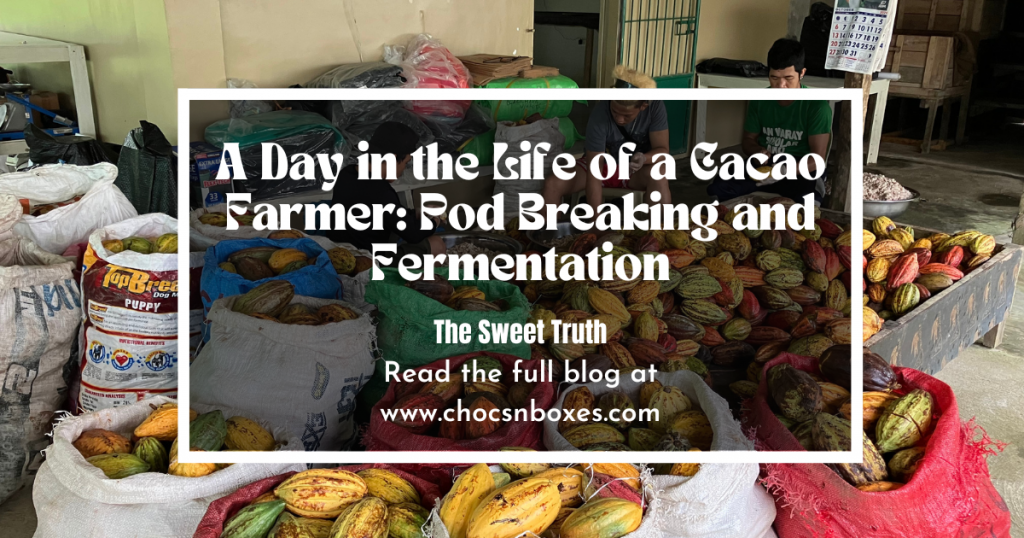
A Day in the Life of a Cacao Farmer: Pod Breaking and Fermentation

Today was a bustling day here on the cacao farm. The team and I spent the morning harvesting the ripe cacao pods, each one a bright burst of color against the lush greenery. It’s always satisfying to see the fruits of our labor ready for the next step in the chocolate-making process. Carefully, we extracted these beans, ensuring none were damaged in the process. Each bean contains the potential for creating rich, flavorful chocolate, and with each pod we opened, anticipation for the final product grew. https://chocsnboxes-old.ad-wize.org/wp-content/uploads/2024/11/WhatsApp-Video-2024-11-13-at-8.08.00-AM.mp4 The beans were then transported to our fermentation area, where we placed them inside wooden boxes made of “santol” wood. This is a crucial step in transforming the raw beans into something truly special. Fermentation develops the flavors and characteristics of the cacao, setting the stage for delicious chocolate down the line. There are two stages in cacao bean fermentation, and today we focused on initiating the anaerobic fermentation. To do this, we layered banana leaves over the beans—a practice that encourages the growth of essential enzymes and microorganisms. The banana leaves play a vital role, acting as a natural catalyst for fermentation. After the banana leaves, we covered the beans with a jute sack, which helps maintain the necessary conditions for fermentation. A thermometer was carefully inserted to monitor the temperature, a critical factor in ensuring successful fermentation. The challenge, as always, is maintaining the right environment for fermentation. We faced the usual concern of ensuring the temperature remains stable—too cold, and the fermentation process could stall; too hot, and we risk spoiling the beans. Vigilance is key, and frequent checks ensure everything progresses smoothly. Despite these challenges, the sight of the beans tucked securely in their santol wood boxes, with the banana leaves and jute sack in place, gives me confidence that we’re on track for another successful batch. Until the next entry, I’ll be monitoring the fermentation closely, eager to see how the flavors develop. Looking forward to the next steps in our delicious adventure from bean to bar!

A Day in the Life of a Cacao Farmer: Pod Breaking and Fermentation Read More »

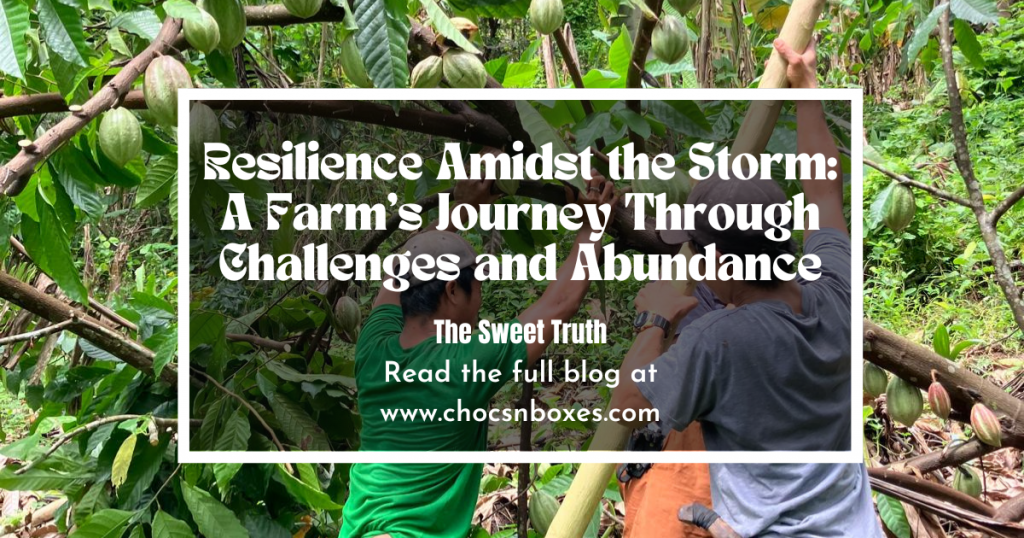
Resilience Amidst the Storm: A Farm’s Journey Through Challenges and Abundance

It’s been an eventful week at the farm, one marked by both challenges and triumphs. Just like most parts of the Philippines, our farm was hit by Typhoon Helen. The storm was fierce, and we braced ourselves for the worst, watching as the winds howled and rain poured down in sheets. When the skies finally cleared, we ventured out to survey the damage, and while we found some trees had succumbed to the wind’s force, we took solace in the resilience of our farm. The majority of our cherished trees stood strong, their roots gripping the earth with determination. Our dedicated farmers wasted no time in helping those that had fallen. They crafted supports out of bamboo, ingeniously stabilizing the trees to give them a fighting chance to recover. It’s moments like these that remind me of the unwavering spirit and creativity of our community. A few days have passed since the typhoon, and I’m excited to share that, against all odds, we are experiencing a bountiful harvest. The richness of our produce remains a testament to the hard work and dedication that define every aspect of Chocs ‘N Boxes. The sweet aroma of our cacao fills the air, offering a comforting reminder of the cycles of life and the enduring joys of being stewards of the land. Reflecting on this week, I’m filled with gratitude for the tenacity of nature and the devotion of our team. As we move forward, we continue to nurture our crops and our spirits, embracing both the challenges and the delightful moments that come with life on the farm.

Resilience Amidst the Storm: A Farm’s Journey Through Challenges and Abundance Read More »

Why Good Agricultural Practices (GAP) Certification is Important : The Sweet Truth

Achieving Excellence: Our Journey to GAP Certification and UGMAD Award Recognition In the world of agriculture, where the quality and safety of produce is paramount, certifications like Good Agricultural Practices (GAP) can make a significant difference. GAP certification is not just a badge of honor; it’s a testament to a farm’s commitment to maintaining high standards of food safety and sustainability. Today, we’re proud to share our journey towards achieving GAP certification and the recognition we received as Outstanding GAP Certified Farm at the prestigious UGMAD Awards. What is Good Agricultural Practices (GAP) Certification? GAP certification is a voluntary program that verifies a farm’s adherence to rigorous food safety practices through an independent third-party audit. The certification ensures that farms implement sound practices in areas such as soil management, water usage, pest control, and worker hygiene. These practices are crucial for producing safe, high-quality food while also protecting the environment and farm workers.In the Philippines, the Bureau of Plant Industry leads the GAP certification program, offering it free of charge to farmers who are willing to open their records, facilities, and farms to thorough inspection. The process is designed to ensure transparency and accountability, providing consumers with confidence in the safety and quality of the produce they purchase. Our Cacao Farm’s Journey to GAP Certification Our journey towards GAP certification began with a commitment to excellence and a desire to set new standards in cacao farming. We understood that achieving this certification would require meticulous attention to detail and a willingness to embrace rigorous inspections and audits. Here’s a closer look at how we achieved this milestone: 1. Opening Our Farm to Inspection The first step in the GAP certification process was to open our farm to the Bureau of Plant Industry for a comprehensive inspection. This involved making our records, facilities, and farming practices available for scrutiny. We were confident in our methods but knew that transparency was key to earning this certification. 2. Adhering to Rigorous Standards The inspection process was thorough, examining every aspect of our farm’s operations. We had to ensure that our soil management practices were sustainable, our water usage was efficient, and our pest control methods were safe and effective. Worker hygiene and safety were also critical components of the inspection, requiring us to implement best practices to protect our team. 3. Passing the Requirements After months of hard work and dedication, we were thrilled to learn that our cacao farm had passed the requirements for GAP certification. This achievement was a significant milestone for us, as it demonstrated our commitment to producing safe, high-quality cacao while maintaining sustainable and ethical farming practices. Recognition at the 2024 UGMAD Awards Our journey didn’t end with GAP certification. In fact, it marked the beginning of even greater recognition. On April 27, 2024, our farm was honored at the prestigious UGMAD Awards, where we were named the Outstanding GAP Certified Farm for 2024. The UGMAD Awards: Celebrating Excellence in Agriculture The UGMAD Awards is an annual event that recognizes outstanding farmers and fisherfolk in the Visayas region. Winning this award is a significant achievement, as it highlights the dedication and innovation of those who excel in agriculture. Being recognized as the Outstanding GAP Certified Farm was a moment of immense pride for us and a testament to our commitment to excellence. The Impact of the Award Winning the UGMAD Award has had a profound impact on our farm and our community. It has elevated our reputation as leaders in sustainable and safe cacao farming, attracting attention from industry peers, consumers, and potential partners. The recognition has also inspired us to continue pushing the boundaries of excellence in agriculture, setting new standards for others to follow. The Future of Our Cacao Farm As we look to the future, we’re excited about the possibilities that lie ahead. Our GAP certification and UGMAD Award recognition have provided us with a strong foundation to build upon, and we’re committed to continuing our journey of excellence in cacao farming. Expanding Our Practices We aim to expand our sustainable and safe farming practices, sharing our knowledge and experiences with other farmers in the region. By doing so, we hope to contribute to the overall improvement of agricultural standards in the Philippines and beyond. Innovating for the Future Innovation remains at the heart of our operations. We’re constantly exploring new technologies and methods to enhance our farming practices, improve efficiency, and reduce our environmental impact. Our goal is to remain at the forefront of cacao farming, setting new benchmarks for quality and sustainability. Engaging with Our Community Our success would not be possible without the support of our community. We’re committed to giving back by engaging with local schools, offering educational programs, and supporting initiatives that promote sustainable agriculture. By fostering a sense of community and collaboration, we aim to create a positive impact that extends beyond our farm. Conclusion Achieving GAP certification and being recognized as the Outstanding GAP Certified Farm at the UGMAD Awards are milestones that reflect our dedication to excellence in cacao farming. These achievements underscore the importance of implementing rigorous food safety practices and embracing transparency and sustainability in agriculture. As we continue our journey, we’re excited to build on these accomplishments and explore new opportunities for growth and innovation. We invite you to join us on this journey, whether you’re a fellow farmer, a consumer, or simply someone who shares our passion for sustainable and safe agriculture. Together, we can create a brighter future for agriculture, one that prioritizes quality, safety, and sustainability for generations to come. Thank you for being a part of our story, and we look forward to sharing more milestones with you in the future.

Why Good Agricultural Practices (GAP) Certification is Important : The Sweet Truth Read More »

Shopping Cart
Scroll to Top